

Do you understand your business finances?
You get your financial statements every month.
You open the report, look at the profit, maybe check the bank balance, and then move on.
There are pages of numbers, accounting terms and comparisons, but you’re not completely sure what you’re supposed to be looking for.
If that sounds familiar, you’re not alone.
You don’t need to become an accountant to understand your business finances. But as a business owner, you should understand enough to know how your business is performing, where your cash is going and whether there are any problems developing.
The easiest way to get there is to learn your numbers in stages.
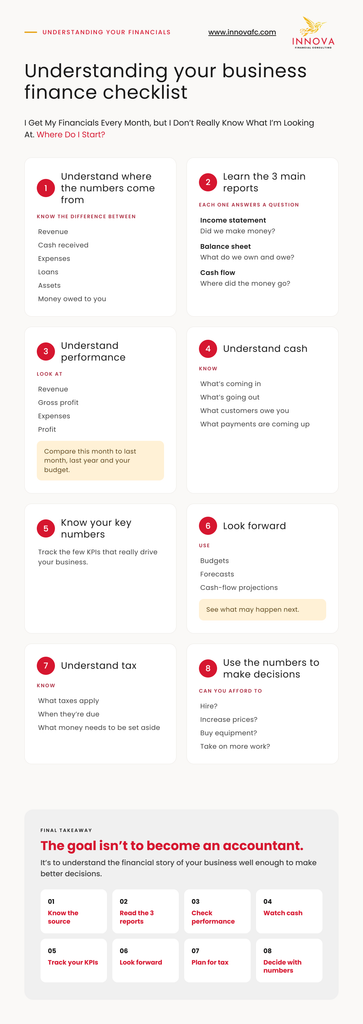
Start by understanding where the numbers come from
Before trying to understand your financial statements, understand what sits behind them.
Every number in your financials comes from something that happened in the business.
You sent a customer an invoice.
A customer paid you.
You bought stock.
You paid salaries.
You bought equipment.
You took out a loan.
Your accountant or bookkeeper records those transactions, and eventually they appear in your financial reports.
You don’t need to understand debits and credits.
But you should understand basic differences such as:
- Revenue is not the same as cash received.
- Profit is not the same as the amount sitting in your bank account.
- A loan is not income.
- Buying equipment is different from paying a normal monthly expense.
- Money owed to you by customers is still part of your financial position, even if it hasn’t reached your bank account yet.
Once you understand that, your financial statements start becoming much less mysterious.
Next, learn the three main financial reports
There are three reports you should become comfortable with.
1. Your income statement
Your income statement tells you how the business performed over a period of time.
At a basic level, you want to understand:
Revenue
How much did the business sell?
Direct costs
What did it cost you to deliver those products or services?
Gross profit
How much was left after those direct costs?
Operating expenses
What did it cost to run the business — salaries, rent, software, marketing and other overheads?
Profit
What was ultimately left?
Don’t just look at the final profit number.
Start asking why the number looks the way it does.
Did revenue increase?
Did your costs increase faster than revenue?
Did your gross margin fall?
Was there an unusual expense this month?
This is where you start moving from simply receiving financial statements to actually understanding your financial performance.
2. Your balance sheet
The balance sheet can feel more difficult to understand, but it doesn’t need to be.
Think of it as a snapshot of where the business stands financially.
It tells you things such as:
- how much cash the business has;
- how much customers owe you;
- what assets the business owns;
- how much you owe suppliers;
- how much debt the business has; and
- what value has accumulated in the business.
Try connecting the numbers to things you recognise.
If your debtors are R500,000, that means customers still owe your business approximately R500,000.
If your supplier balance is R200,000, that is money the business still needs to pay.
If your loan balance is R1 million, that is an obligation the business has to repay.
The balance sheet becomes easier when you stop seeing it as an accounting report and start seeing it as a picture of what your business owns and owes.
3. Your cash flow
This is one of the most important areas for a business owner to understand.
A business can be profitable and still run out of cash.
For example, you may have made a large sale this month, so the profit appears in your income statement.
But if the customer only pays you in 60 days, the cash isn’t in the bank yet.
At the same time, you still need to pay salaries, suppliers, rent and tax.
That is why profit and cash are not the same thing.
You need to understand:
- what cash is coming into the business;
- what cash is going out;
- when customers are likely to pay you;
- when suppliers need to be paid;
- what tax payments are coming; and
- whether you have enough cash for the next few weeks and months.
A simple cash flow forecast can often tell you more about the immediate health of the business than simply looking at the current bank balance.
Then start understanding how the business is actually performing
Once you understand your reports, the next step is to interpret them.
This means moving beyond:
“We made R200,000 profit.”
And starting to ask:
Is that good?
Look at your numbers in context.
Compare this month to last month.
Compare this year to last year.
Compare actual results to your budget.
Look at trends.
You might find that revenue has increased by 20%, but expenses have increased by 30%.
Or sales are growing, but customers are taking longer to pay you.
Or one part of the business is very profitable while another barely breaks even.
This is where financial statements become useful.
Learn the few numbers that really drive your business
You do not need to track 30 different ratios.
Start with a handful of numbers that tell you what is happening in your business.
For many small businesses, that might include:
- Revenue
- Gross profit margin
- Operating profit
- Cash in the bank
- Amount owed by customers
- Amount owed to suppliers
- Staff costs
- Tax due
- Cash expected over the next 13 weeks
Your industry might have other important numbers.
A software company may look at monthly recurring revenue and customer churn.
A retailer may focus more heavily on stock and gross margin.
The important thing is knowing which numbers tell you whether your business is moving in the right direction.
Then learn to look forward
Your financial statements tell you what has already happened.
Financial management also means looking ahead.
This is where budgets and forecasts become important.
A budget asks:
What do we expect to happen?
A forecast asks:
Based on what we know today, what is now likely to happen?
A cash flow forecast asks:
Will we actually have enough money to pay everything?
This changes the way you use your numbers.
Instead of discovering a cash shortage when the bank account is nearly empty, you may see the problem six or eight weeks earlier and have time to do something about it.
Understand your tax obligations
You don’t need to know how to complete every tax return yourself.
But you should understand the basic tax obligations of your business.
You should know:
- what taxes you’re registered for;
- when returns and payments are due;
- roughly how those taxes are calculated;
- what money needs to be set aside; and
- what information your accountant needs from you.
Tax should not be something you only think about when SARS sends you a notice.
It should form part of your financial planning throughout the year.
Finally, start using your numbers to make decisions
This is really the goal.
Financial literacy isn’t about being able to explain every line in a balance sheet.
It’s about being able to make better decisions.
Can we afford to hire another employee?
Can we take on this contract?
Should we increase our prices?
Can we afford new equipment?
Why is cash getting tighter even though sales are increasing?
Which service is actually making us money?
Can we afford to take more money out of the business?
Those are the questions your financial information should help you answer.
You don’t have to learn everything at once
If you currently don’t understand your financial statements, don’t start by trying to learn everything about accounting.
Start with your own business.
Take your latest management accounts and ask:
What happened this month?
Why did it happen?
How much profit did we make?
Where is the cash?
What do customers owe us?
What do we owe?
What is coming over the next few months?
Is there anything I should be worried about?
Then do it again next month.
And the month after that.
Over time, the numbers will stop feeling like something your accountant gives you and start becoming something you actually use to run your business.
You don’t need to become an accountant.
But you do need to understand the financial story of your own business.
If you need any help with the above, contact me using the contact form here: https://innovafc.com/contact/