
Individual Tax Season 2026 opens today.
Here are the big deadlines:
📅 Auto Assessments: 1 – 12 July 2026
📅 Filing opens (all other taxpayers): 13 July 2026
📅 Non-provisional taxpayer deadline: 23 October 2026
📅 Provisional taxpayers and trusts: 22 January 2027
The tax year being assessed runs from 1 March 2025 to 28 February 2026.
In this special edition in the upcoming weeks, I’ll be covering:
- News updates from SARS
- Tips for your Tax season to go as smooth as possible
- Mistakes I’ve seen made by Taxpayers, based on my own experience as well as documented case law
- Any AI tips to put the your Taxes together.
- Anything else that comes to mind.
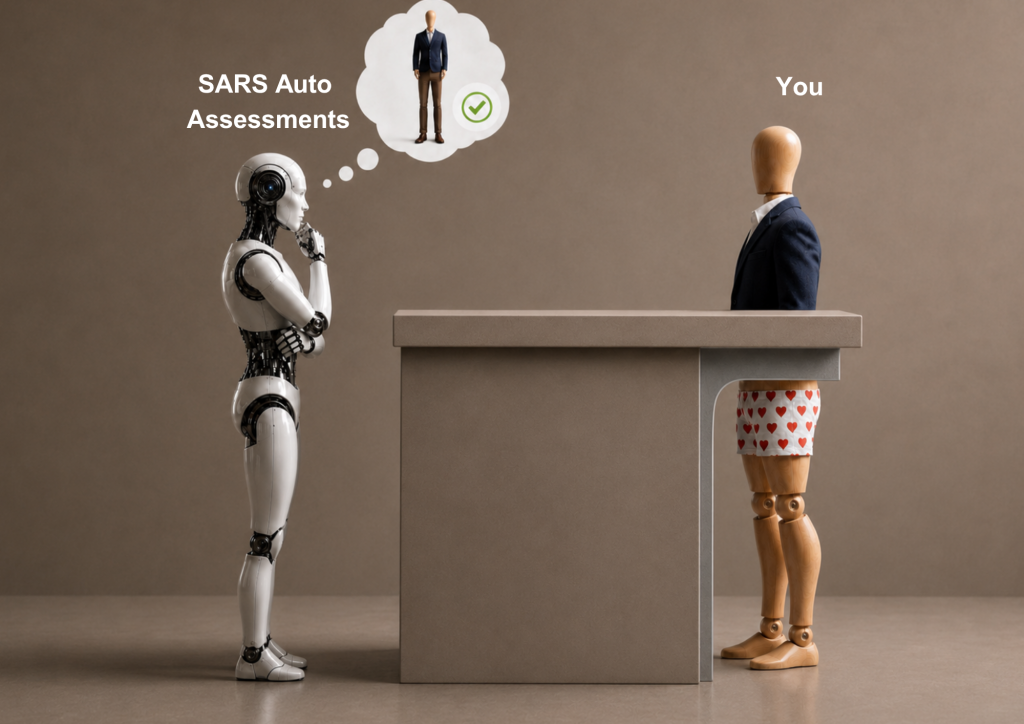
Let’s start with auto-assessments and how they can lead to stress
A client came to me at the beginning of the year because she wanted to get her finances up to date.
She was working as a consultant, so we needed to register her as a provisional taxpayer and submit the right returns.
Simple enough.
Except there was one problem.
During that same tax year, she had also been employed.
She had a fairly well-paid job, and her employer had submitted her IRP5 information to SARS. Based on that information, SARS calculated that she was due a refund.
A very nice refund.
The kind of refund that makes you think:
“Well done, me. I am clearly excellent at tax.”
Except she had also earned consulting income during the year.
And SARS did not have the full picture.
What went wrong with the SARS auto-assessment?
SARS auto-assessment is basically SARS saying:
“Based on the information we already received, this is what we think your personal tax return should look like.”
It is not SARS saying:
“Everything is definitely complete and correct. Please go spend that refund immediately.”
That is where many taxpayers get caught.
SARS uses third-party information from employers, banks, medical schemes, retirement funds and similar institutions to prepare an auto-assessment. For someone with one salary and very simple tax affairs, that may be mostly correct.
But if you are a business owner, consultant, director, freelancer, landlord, investor, or you earn income from more than one place, you need to slow down.
Because SARS may not know everything yet.
In this client’s case, SARS had her employment income.
But it did not have the full picture of her consulting income.
So the refund looked correct.
Until we corrected the return.
The refund became a tax bill
Once the consulting income was included, the position changed completely.
Instead of being in a refund position, she actually owed tax.
And this is the part many people miss:
If SARS pays you a refund and your corrected tax return later shows that you actually owed tax, you may need to pay back the refund and pay the tax that was due.
So, using simple numbers:
SARS pays you a refund of R40,000
Your corrected return shows you actually owe R20,000
You do not just “lose” the refund
You may need to pay back the R40,000 plus settle the R20,000
That is how a refund can turn into a R60,000 problem.
The danger with more than one income stream
This is especially important if you earn from more than one place.
For example, maybe you have:
- A salary from one company
- Director’s remuneration from another company
- Consulting income on the side
- Rental income
- Freelance work
- Investment income
Each income stream may look small or manageable on its own.
But SARS taxes you on your combined taxable income.
That means once everything is added together, you may fall into a different tax position.
This is where business owners get surprised.
Not the fun kind of surprise.
The “why is SARS asking me for money?” kind.
What you should do when you receive a SARS auto-assessment
Please do not just accept it because there is a refund.
A refund is not proof that the assessment is correct.
Before you do anything, log into eFiling or the SARS MobiApp and compare the auto-assessment to your own records.
Check:
- Your IRP5s
- Your payslips
- Medical aid certificate
- Retirement annuity certificate
- Interest certificates
- Investment certificates
- Rental income
- Business income
- Consulting or freelance income
- Any deductions you want to claim
- Any income SARS may not have picked up
If everything is complete and correct, fine.
But if anything is missing, incorrect, or incomplete, you need to file an updated tax return through eFiling or the SARS MobiApp.
And if the third-party information itself is wrong, for example your employer, bank, medical scheme or retirement fund submitted incorrect information, you usually need that provider to correct and resubmit the information to SARS.
You won’t be able to edit it within the return.
Final thought
SARS auto-assessment can be convenient. It can make tax season easier.
But it is only as good as the information SARS has. If your tax affairs are simple, it may be fine.
But if your income is even slightly more complicated, please do not click through because the refund looks exciting.
That refund might be real.
Or it might be a very expensive “oops”. And business owners already have enough expensive oopsies to deal with.
If you have been auto-assessed and you are not sure whether SARS has picked up all your income and deductions, let’s check it properly before that refund turns into a tax bill.
Need help with your tax return? Contact me here and I’ll get back to you in 24 hours.
Was this helpful?
Sign up here to get more like it