
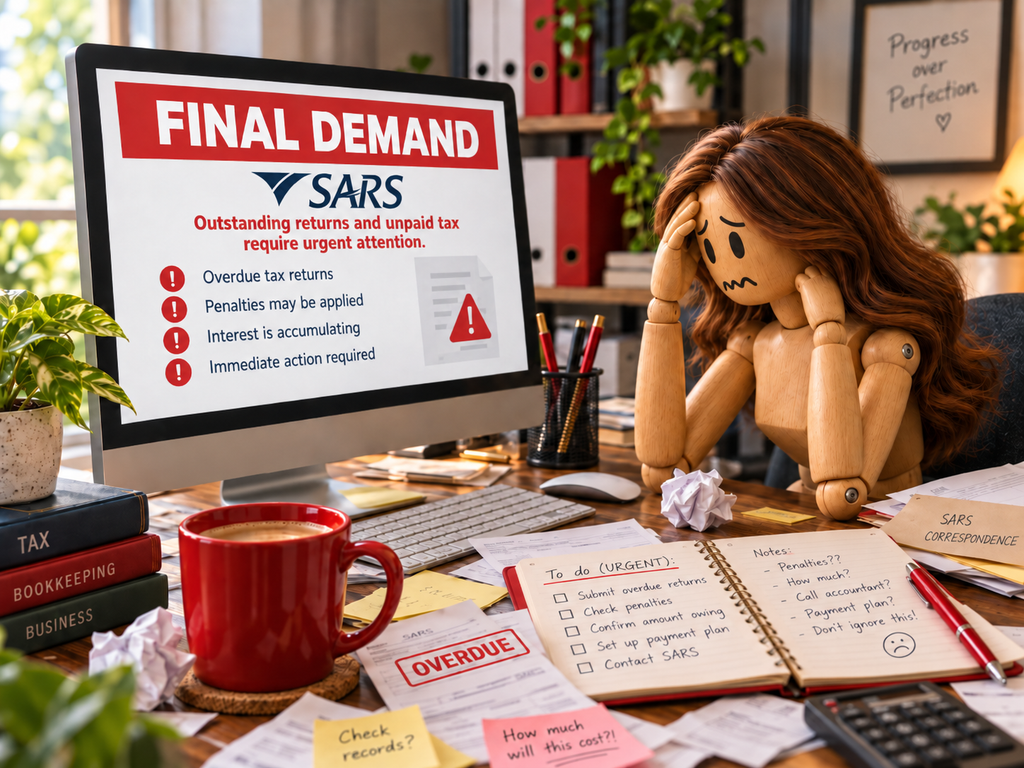
If you owe SARS money and have outstanding tax returns and your bookkeeping is months — or even years — behind, it can feel like a very difficult problem to fix.
The good news is that there is a process.
The important thing is not to start randomly submitting returns or making payments just because you want to get something done.
You first need to understand exactly where you stand.
In most cases, there are actually three problems that need to be dealt with together:
- Your bookkeeping is behind.
- Your tax returns are outstanding.
- You may owe SARS money.
Here is the process I would normally follow to start getting things under control.
Step 1: Find Out Exactly What Is Outstanding With SARS
Before fixing anything, you need a proper picture of your SARS profile.
Log into SARS eFiling and check which tax types your business is registered for.
Depending on the business, this could include:
- Company Income Tax
- VAT
- PAYE
- UIF and SDL
- Provisional Tax
Then identify which returns have been submitted and which ones are still outstanding.
You should also download your SARS Statements of Account.
This is important because the amount you see owing to SARS may not only be tax.
It could include:
- unpaid tax
- penalties
- interest
- estimated assessments
- older amounts that have accumulated over time
At this stage, you are not trying to solve the problem yet.
You are trying to answer one question:
What exactly is outstanding?
Until you know that, it is very difficult to put together a sensible plan.
Step 2: Get the Bookkeeping Up to Date
This is usually where most of the work starts.
If your books haven’t been updated for months or years, you may not actually know what your tax position should be.
Your accountant or bookkeeper will normally need to reconstruct the accounting records using documents such as:
- bank statements
- sales invoices
- supplier invoices
- payroll reports
- loan statements
- credit card statements
- asset purchases
- contracts
- previous financial statements
- previously submitted SARS returns
The bank account is often the starting point.
Every transaction needs to be recorded and properly classified.
For example, money entering the bank account could be:
- sales
- a loan
- money introduced by the owner
- a transfer between bank accounts
Those transactions are treated very differently for accounting and tax purposes.
The same applies to expenses.
A payment appearing on your bank statement does not automatically mean that it is a tax-deductible business expense or that you can claim VAT on it.
The supporting documents still matter.
Step 3: Reconcile the Accounts Before Submitting Returns
Once the transactions have been captured, the accounts need to be reconciled.
This is the step that is often missed when businesses try to rush through a backlog.
Your bank balance in the accounting system should agree to the actual bank statement.
If you are VAT registered, your VAT records should agree to the sales and purchases in the accounting records.
If you have employees, payroll should agree to your PAYE declarations and EMP201s.
The aim is to get to a point where the numbers being submitted to SARS can actually be supported.
I would rather spend additional time getting the numbers right than submit returns simply to remove them from the outstanding list.
Submitting an incorrect return can create a second problem that then needs to be fixed later.
Step 4: Submit the Outstanding Returns
Once the accounting records for a period are reasonably complete, you can start preparing the outstanding SARS returns.
Depending on the business, this might include outstanding:
- VAT201 returns
- EMP201 returns
- EMP501 reconciliations
- company income tax returns
- provisional tax returns
Normally, I prefer working from the oldest accounting period forward.
There is a simple reason for this.
Your closing balances from one financial year become the opening balances for the next year.
Fixing 2024 properly makes it much easier to fix 2025.
There are exceptions.
If SARS has issued an urgent notice or there is a current return that needs to be submitted before a deadline, that may need to be dealt with first.
Step 5: Work Out What You Actually Owe SARS
Once the returns are submitted, you can start getting a much clearer picture of the real SARS debt.
Your SARS balance could include several different amounts:
Tax
This is the actual VAT, PAYE, income tax or other tax that should have been paid.
Penalties
SARS can impose penalties for certain forms of non-compliance, including outstanding returns.
Some administrative penalties can also continue recurring while the non-compliance remains unresolved.
Interest
Interest can continue accumulating on unpaid tax.
This is one reason why ignoring SARS debt tends to make the problem more expensive over time.
Once the backlog has been dealt with, I would reconcile SARS’s Statement of Account to the returns that were submitted and the payments previously made.
You want to understand exactly what makes up the balance.
Step 6: Decide How You Are Going to Deal With the SARS Debt
This is where many business owners panic.
They see a large SARS balance and assume they need to find all the money immediately.
That is not always the only option.
Depending on your circumstances, SARS has mechanisms available for taxpayers who cannot settle their tax debt immediately.
Option 1: Pay the debt
If the debt is correct and the business has enough cash to settle it without putting the business under financial pressure, paying it will obviously resolve the debt fastest.
But I would still consider the business’s cash flow.
Using every cent available to pay old SARS debt and then being unable to pay next month’s VAT or PAYE simply creates a new problem.
Option 2: Apply for a SARS payment arrangement
If the business cannot pay the full amount immediately but can afford monthly payments, it may be possible to request a payment arrangement from SARS.
SARS will normally want to understand the taxpayer’s financial position and ability to repay the debt.
For more substantial arrangements, this can include financial information such as cash-flow forecasts, bank statements, assets and liabilities.
The payment amount also needs to be realistic.
There is no benefit in agreeing to an instalment that the business cannot afford and then defaulting three months later.
Option 3: Consider a compromise of tax debt
There are circumstances where SARS may consider accepting less than the full tax debt through the formal compromise process.
This is very different from simply asking SARS for a discount.
The taxpayer normally needs to provide detailed financial information showing their financial position, assets, liabilities, cash flow and what SARS could realistically recover.
A compromise is therefore more relevant where paying the full debt may simply not be financially possible.
Professional tax advice is strongly recommended before going down this route.
What If the Amount SARS Says You Owe Is Wrong?
Do not automatically enter into a payment arrangement for a SARS assessment you genuinely believe is incorrect.
There are formal objection and dispute processes available.
Depending on the circumstances, it may also be possible to request a suspension of payment while the dispute is being dealt with.
The important point is to separate these two questions:
Do I owe the money?
and
Can I afford to pay the money?
They are not the same problem.
What If Previous Tax Returns Were Incorrect?
This needs to be handled carefully.
There is a big difference between bookkeeping simply being behind and discovering that previous returns contained significant undeclared income, incorrect deductions or other tax defaults.
SARS has a Voluntary Disclosure Programme (VDP) that may be relevant in certain circumstances.
However, there are specific requirements for a valid voluntary disclosure, and timing matters — particularly if SARS has already started an audit or investigation.
If you discover significant historical tax errors, I would get professional tax advice before simply amending and submitting everything.
Don’t Forget About Current Tax Returns
This is one of the most important parts of fixing a tax backlog.
While you are fixing the past, do not allow the current period to fall behind as well.
I normally think about it as two separate workstreams.
Workstream 1: Fix the past
Bring the old bookkeeping and outstanding tax returns up to date.
Workstream 2: Keep today compliant
Make sure current bookkeeping, VAT, payroll and tax submissions are completed on time.
Otherwise, six months into the cleanup you may discover that you have simply created another six months of outstanding returns.
What Happens If You Ignore SARS Debt?
Ignoring the problem normally makes your options worse rather than better.
Depending on the circumstances, SARS has a number of debt collection mechanisms available.
These can include taking money through third parties such as a bank, pursuing civil recovery processes and attaching assets.
Penalties and interest may also continue accumulating.
This does not mean you should panic if you discover that you have a tax backlog.
It does mean you should start dealing with it.
Where Should You Start?
If your accounting and SARS affairs have fallen behind, I would start with these four questions:
1. What tax returns are outstanding?
2. How far behind is the bookkeeping?
3. How much does SARS currently say is owed?
4. Are there any SARS notices, demands or deadlines that need immediate attention?
From there, you can build a proper cleanup plan.
The process is normally:
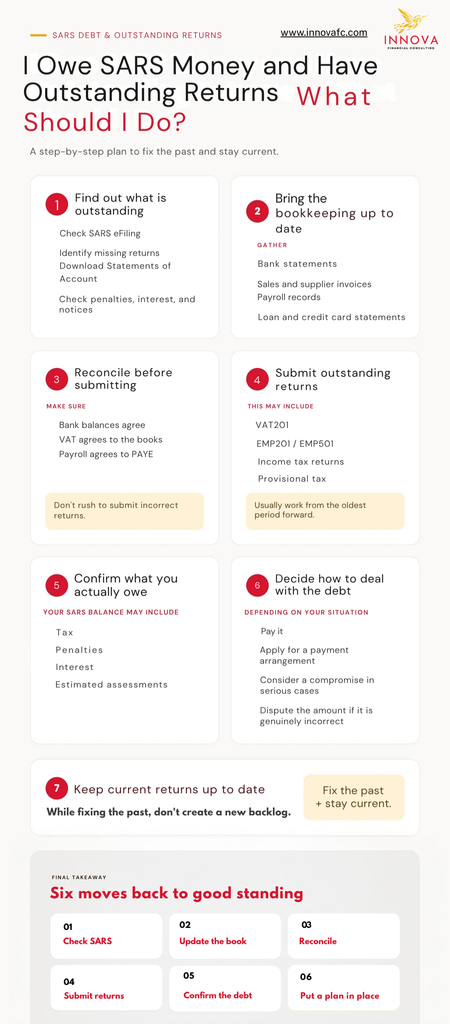
Understand the SARS position → update the bookkeeping → reconcile the accounts → submit the outstanding returns → confirm the real SARS debt → put a plan in place to deal with it.
The situation normally becomes much more manageable once you stop looking at it as one enormous SARS problem and start breaking it down into individual returns, accounting periods and actions.
The most important step is simply getting a clear picture of where you stand.
This article provides general information and should not be considered individual tax or legal advice. The appropriate approach will depend on your particular circumstances and the taxes involved.
If you need any help with the above, contact me using the contact form here: https://innovafc.com/contact/